




Triple O Finance

Generic selectors
Exact matches only
Search in title
Search in content
Post Type Selectors
page
post

Can Police Officers Get a Home Loan During Probation? Here's the Truth

Home / Blog Posts / Can Police Officers Get a Home Loan During Probation? Here’s the Truth
Police graduates celebrating by throwing their hats after completing academy training
Home / Blog Posts / Can Police Officers Get a Home Loan During Probation? Here’s the Truth

Can police officers get a home loan during probation? Here’s the truth: yes, they can. This article will guide you through the options and requirements to make it happen.

Key Takeaways

  • Police officers on probation have access to tailored mortgage options from specialist lenders that take into account their job stability and future earning potential.
  • Government schemes and support programs, including key worker mortgages and shared ownership options, can help police officers secure home loans despite financial challenges during probation.
  • Engaging a mortgage broker and improving financial profiles, such as maintaining a good credit score and combining incomes, can enhance the chances of securing favorable loan terms.

Home Loan Options for Police Officers on Probation

: A digital illustration showing various home loan options available for Australian police officers

Police officers on probation have access to various home loans. Although the mortgage market might seem intimidating, several options cater specifically to their unique circumstances. Specialist mortgage lenders recognize the nature of police work and offer tailored solutions that consider job security and future earning potential. This personalized approach can significantly benefit those just starting in the police force with police mortgages.

Even trainee officers can secure a mortgage during their training period, showcasing the flexibility some lenders offer a loan offer. Finding the right lender who views police officers as stable and reliable borrowers is crucial to ensure that a person can pay their paid obligations.

Although there aren’t dedicated mortgage products specifically for police officers, standard loans are often suitable and can be tailored to fit their needs. The following sections focus on specialist mortgage lenders and government schemes and support.

Specialist Mortgage Lenders

Related Topics

Let's connect


Caucasian male Australian police officer standing confidently with folded arms, symbolising readiness to take action on a home loan application.

Specialist mortgage lenders are an excellent resource for police officers on probation. These lenders provide loan solutions tailored for professionals like police officers, considering their job stability and future earning potential. Improved loan-to-value ratios and lower deposit thresholds are some benefits. Consulting a mortgage broker can be advantageous, as brokers have the expertise to identify lenders offering special terms for police officers.

Mortgage brokers can help find lenders more accommodating to probationary officers, which is especially beneficial for first-time buyers without substantial savings. By working with specialist lenders, police officers can access mortgage options that align with their specific needs, making the home-buying process smoother.

Related Topics


Government Schemes and Support

Government schemes play a crucial role in helping police officers secure home loans during probation. Various programs support first-time buyers, including those in the police force, by reducing the financial burden of purchasing a home.

Key worker mortgages become available to police community support officers after they pass probation. Additionally, shared ownership schemes allow officers to buy a share of a property, requiring a smaller deposit.

These government-backed initiatives make homeownership more accessible and affordable, even for those on probation.

Eligibility Requirements

Australian police officer holding a house key, symbolising homeownership success through a tailored home loan.

Police officers on probation must understand the eligibility requirements to secure a home loan. Lenders have specific criteria that can vary significantly. Factors such as length of service and job stability positively influence mortgage applications, but probationary officers may face stricter lending policies due to their employment status.

Being rejected by one lender does not affect decisions by other lenders. In joint applications, merging incomes can significantly increase borrowing capacity, allowing access to higher loan amounts to borrow.

This section will delve into the specific requirements for income verification and credit history, providing clarity on what lenders expect.

Income Verification

Income verification is crucial in the home loan application process. Police officers must provide documents like employer letters, recent payslips, and tax returns to demonstrate their ability to repay the loan. Consistent income documentation is vital for showing repayment capability.

Maintaining a stable job and consistent income significantly increases the likelihood of loan approval. Lenders also consider additional income forms, such as overtime and government benefits, which can strengthen the applicant’s financial profile. Demonstrating genuine savings and reducing overall debt levels are also beneficial when applying for a home loan.

Credit History and Score

Illustration of a police officer evaluating credit score factors for a home loan application.

A good credit history is essential for securing a home loan. Lenders perform thorough checks on an applicant’s credit history. For police officers with poor credit, higher interest rates and stricter lending conditions may apply. Maintaining a strong credit score and a clean repayment history can significantly enhance loan approval chances.

Reducing credit card balances and discussing credit status candidly with a mortgage advisor are effective strategies to improve a credit score. Advisors can also help officers with poor credit find lenders specializing in bad credit mortgages. By focusing on these areas, police officers can improve their credit profiles and increase their chances of securing a favorable home loan.

Overcoming Common Barriers

Overcoming common barriers is crucial for securing a home loan during probation. Police officers face unique challenges, such as saving for a deposit and relying heavily on overtime income. However, the job security associated with being a police officer can positively influence mortgage lenders’ willingness to work with them.

One strategy to overcome these barriers is to consider a guarantor who can provide additional security for the loan. Another option is to explore No Deposit Home Loans, which typically require a strong credit history and stable employment. Special schemes like the First Home Loan Deposit Scheme (FHLDS) can also assist first-time buyers in securing a no deposit home loan.

This section will further explore higher interest rates and lenders mortgage insurance as common barriers and how to manage interest rate them.

Higher Interest Rates

Flat illustration of a police officer comparing home loan interest rate options.

Higher interest rates pose a common challenge for police officers on probation who are applying for home loans. Lenders typically impose elevated interest rates on borrowers without a deposit due to the increased risk. Higher rates and stricter terms are also common for loans approved with bad credit.

Negotiating with mortgage brokers can potentially lead to lower interest rates for probationary employees. Considering guarantors for loans with higher interest rates can provide additional security. By exploring these strategies, police officers can manage higher interest rates and secure more favorable loan terms.

Lenders Mortgage Insurance (LMI) is required when borrowing over 80% of a property’s value, significantly impacting the total loan cost. No Deposit Home Loans, allowing borrowing the full purchase price without a deposit, often come with higher interest rates and LMI costs.

Calculating all expenses before committing to a No Deposit Home Loan is crucial, as high property prices can lead to significant associated costs. Some lenders, offer LMI waivers for owner-occupier home loans up to 90% LVR, helping reduce upfront costs. Please contact our team at Triple O Finance to see if you are eligible for LMI waiver by clicking here.

By understanding and managing LMI, police officers can better prepare for their home loan journey.

Related Articles

Joint Applications

Joint applications can significantly increase overall buying power, making it easier for police officers on probation to secure home loans. Individuals applying for a joint mortgage can also benefit from government bonuses, such as the £1,000 a year from a Lifetime ISA (LISA). Only one applicant needs to be an essential worker in a joint application, allowing for more flexibility.

A minimum deposit of 5% is required to qualify for a joint mortgage, which can be easier to achieve when combining savings. Real-life examples, such as Paul and Jennifer, who managed to save $1,500 to $2,000 monthly despite starting with only $5,000 in savings, demonstrate the benefits of joint applications.

This section will explore the advantages of combining incomes and the impact of a partner’s financial status on the mortgage application.

Combining Incomes

Combining incomes in a joint mortgage application can significantly increase borrowing capacity. Sharing financial responsibilities allows multiple borrowers to enhance their approval chances and access better loan terms. This strategy boosts the total income considered for the loan and strengthens the overall application profile.

For police officers during probation, joint applications can be a strategic choice to secure favorable mortgage options.

Impact of Partner's Financial Status

A partner’s financial status plays a crucial role in a joint mortgage application. While combining incomes can improve the chances of securing a loan, a partner’s financial issues can negatively affect the application. Lenders often favor joint applications due to the combined financial strength, but it’s important to consider a partner’s financial situation to maximize the chances of securing a home loan.

By addressing these factors, police officers can better prepare for the joint mortgage application process.

Documentation and Application Process

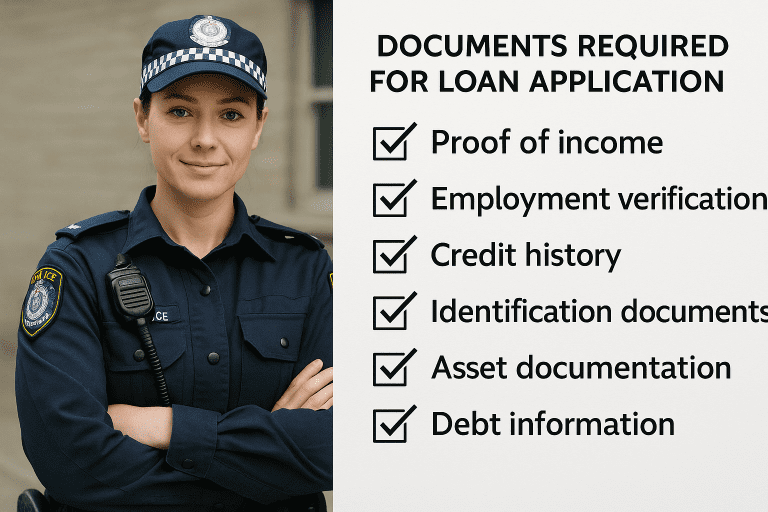
Australian female police officer beside a home loan document checklist illustration.

Preparing the necessary documentation and understanding the application process is vital for securing a home loan. Essential documents include proof of income, bank statements, and identification. These documents are crucial for verifying eligibility and demonstrating financial stability. Hidden costs, such as higher loan-to-value ratios (LVR) and Lenders Mortgage Insurance (LMI), can impact overall affordability.

Following a structured application process can lead to quicker loan approvals. This process typically involves consulting a finance broker, assessing your financial situation, researching and comparing lenders, and gathering necessary documents. Understanding these steps helps police officers navigate the home loan application process more effectively.

Required Documents

The documentation required for a home loan application includes income verification, such as employer letters, payslips, and tax returns. Bank statements are also necessary to substantiate additional income and demonstrate financial stability.

These documents are essential for meeting eligibility requirements and ensuring a smooth application process for eligible applicants.

Application Steps

The initial steps to apply for a home loan include assessing your financial situation, researching and comparing lenders, and gathering necessary documents. Home loan applications can be started online, in-branch, over the phone, or with mobile bankers.

After submitting the application, a lending consultant will review it, and once all required information is received, the application will be assessed for conditional approval. Utilizing a mortgage broker can significantly simplify this process, given their experience and insights.

By following these steps, police officers can improve their chances of securing a home loan.

Tips for Improving Approval Chances

Confident Australian police officer with thumbs up, symbolising improved home loan approval chances.

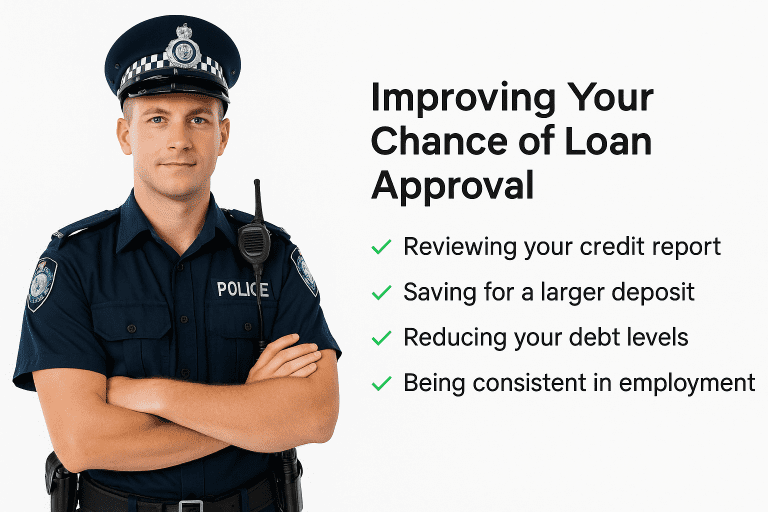
Improving approval chances involves assessing and strengthening one’s financial position. For example, Sarah and John successfully reduced their debts and increased their savings to purchase a $525,000 property. Pooling resources from multiple applicants can facilitate quicker savings for a deposit and help avoid lenders mortgage insurance. This approach can also lead to better management of money.

Engaging a mortgage broker can also make the application process smoother and more efficient. By focusing on financial stability and leveraging professional advice, police officers can enhance their chances of securing favorable loan terms.

Strengthening Financial Profile

Strengthening one’s financial profile is crucial for loan applications. Keeping the credit utilization rate below 30% can enhance the credit score, which is important for loan approvals. Demonstrating a consistent savings history and building a diverse asset base can positively influence lenders’ perceptions of a borrower’s financial stability.

Establishing a budget and systematically increasing savings are also generally favorable for loan applications. Financial goals can be supported by tailored strategies that financial advisors provide to help improve loan application profiles based on individual circumstances.

By focusing on these areas, police officers can strengthen their financial profiles and improve their chances of securing home loans from banks.

Seeking Professional Advice

Engaging with mortgage brokers and financial advisors is crucial for police officers during their probation. These professionals can help navigate the home loan process, identify flexible lenders, and offer tailored advice to improve one’s credit profile. Speaking candidly about one’s financial situation and credit status can lead to finding the best possible mortgage options.

By leveraging professional advice, police officers can speak to make informed decisions and enhance their chances of securing a favorable loan.

Other Related Articles

Case Studies and Success Stories

Real-life experiences of police officers who successfully secured home loans during their probation period can provide valuable insights and inspiration. These stories showcase various financing strategies and highlight the potential for homeownership even during probationary periods, illustrating a unique situation.

By learning from others’ experiences, police officers can better understand the steps and strategies needed to achieve their homeownership goals.

First-time buyers, including those looking to invest, can benefit significantly from no deposit home loans. These loans provide an opportunity to enter the property market without a substantial initial investment. For instance, David and Carra, first-time buyers, qualified for a $780,000 house package despite having only $39,000 saved, thanks to guidance on financing options. Such stories demonstrate that with the right advice and strategies, first-time buyers can achieve the best deal on their homeownership dreams.

A government initiative designed to support first home buyers enabled them to purchase property with just a 5% deposit through participating lenders—without needing to pay Lenders Mortgage Insurance (LMI). By exploring this pathway and learning from the experiences of successful buyers, even police officers on probation can discover practical strategies to secure their first home.

Summary

Securing a home loan during probation is a challenging yet achievable goal for police officers. By exploring various home loan options, understanding eligibility requirements, and overcoming common barriers, officers can navigate the mortgage market effectively. Joint applications, strengthening financial profiles, and seeking professional advice are all strategies that can improve approval chances. Real-life success stories further illustrate that with the right approach, police officers on probation can achieve their homeownership and investment goals. Stay determined, seek the right advice, and make informed decisions to turn the dream of homeownership into reality.

Home / Blog Posts / Can Police Officers Get a Home Loan During Probation? Here’s the Truth

Frequently Asked Questions

Yes, police officers can obtain a home loan during their probation period by seeking out specialist mortgage lenders and government-backed schemes.

For a home loan application, police officers typically need to provide proof of income, bank statements, identification, and recent payslips. Having these documents organized will help streamline the application process.

To improve home loan approval chances, police officers should focus on enhancing their credit scores, maintaining consistent savings, and consulting mortgage brokers for expert guidance. These steps can significantly strengthen their application.

Yes, there are tailored mortgage solutions available for police officers through specialist mortgage lenders that address their unique financial situations. It’s advisable to explore these options to find the best fit for your needs.

A joint mortgage application can enhance borrowing capacity and improve approval chances for police officers on probation by allowing them to combine incomes and financial resources. This collaboration can make homeownership more accessible and financially manageable.

Ashish Shrestha

Ashish is the Co-Founder of Triple O Finance, beginning his finance career in 2018. He specialises in residential and commercial lending, asset finance, and investment portfolio strategies. Ash holds a Graduate Certificate in Management, a Bachelor of Justice Studies, and a Diploma in Mortgage Broking & Finance. Recognised as an Elite Broker by both CBA and NAB—a distinction awarded to top-performing brokers—Ash consistently delivers high-quality outcomes. He is passionate about helping clients make informed, evidence-based financial decisions through trusted partnerships and expert advice.

Related Articles

Scroll to Top